This place is terrible
TERRIBILIS EST LOCUS ISTE

Imago Dei

What is the face of God?

‘Imago Dei’ is a pictorial exhibition of seven paintings, created using the ‘Temporama Alchemico’ technique by Francesco Filippelli, which attempts to answer this question.

Each of the seven paintings, arranged as indicated above, indicates a point in the enneagram, a schematic representation proposed by the Armenian philosopher I. Gurdjieff, valid for any self-consistent universal process. In the exhibition context, the complete nine-point figure is realized only when the observer (point 4) and the author (point 5) are present at the exhibition location.

The aim of the exhibition is to introduce the observer to a journey through time and space, showing how the archetype of God has been realized in image throughout history, from antiquity to the present day.

This brief history of the image of God begins with the origin of sentient life, symbolized (as in many religious traditions) by the breath of life. In this case, the breath comes from an ancient deity, Aeolus (point 1), god of the wind. The death of Medusa (point 2), beheaded, symbolizes the end of antiquity and the beginning of a new era: the Christian era.

The three protagonists of the Passion of Christ here symbolize the three triangular points of the enneagram, which represent active force (point 6, Judas, who triggers the process with his betrayal), passive force (point 3, Mary, the grieving mother), and reconciling force (point 9, Christ, the absolute who welcomes death and transforms it into new life).

With the last two paintings, we finally move to the modern age, in which it is not God who becomes man (as in the Christian tradition), but man who becomes God (point 7, Maradona who becomes Christ being flogged). The process of human deification catastrophically leads to his self-inflicted martyrdom, but it also leads to the death of God, understood as the denial of all spirituality.

The author’s response to materialistic absolutism lies in the last painting (point 8, Mother Teresa of Calcutta becoming Hitler), which embodies the esoteric concept of the union of opposites as distinct characteristics of the same nature.

“Temporama Alchemico” Technique

Transforming Portraits

A step never before taken in painting: breaking down the barrier of timelessness.

The “Temporama alchemico” painting technique is an invention of Francesco Filippelli, whose patent was filed in 2021. Through a purely pictorial process involving the alternating layering of thin layers of classic (chemically stable) colors and colors created with reactive pigment, the artist creates paintings on canvas that transform autonomously and cyclically, independently of the viewer and without the aid of digital tools (such as lights, projectors, and so on).

The term “Temporama” comes from an analogy with the term “panorama.” Indeed, just as by gazing out over a panorama, one can grasp a vast expanse of space, by considering time as a dimension, one can mentally gaze upon a line extending from the origin of the Universe to its distant end, a line in which we, in the present, occupy only an infinitely small point. In this vision, a period (a ‘fragment’ of a timeframe) is not necessarily seen as a single unfolding but can be observed as a whole, in which each moment is part of a perceptual unity.

Artistically conveying this requires access to an inner reality, as real as the physical. Hence, alchemy: through a chemical process, which we might call alchemical (as alchemy is spiritual as well as material transformation), the artist manages to bring to life paintings on canvas that change autonomously and cyclically, independently of the observer.

If a static painting is to be considered a mirror, since when we observe it we project our emotional emotions onto it, in this case the reverse process is triggered: the projection is induced by the metamorphosis of the canvas itself, and like a mirror, the observer reacts by transforming himself; he reestablishes equilibrium through a process analogous and opposite to the painting he faces.

Paintings imbued with an alchemical process reveal a two-way transformation, spread out before us, mutable yet timeless in its transformation: fragments of a temporama of an interior, spiritual time, unfolded and rewound in the execution of the work, a period of the soul that, like a hologram, encloses the entire soul in every point.

Chromaticism

What the eye does not see, the soul grasps

The paintings in ‘Imago Dei’ are characterized by a particular chromaticism that is the result of the artist’s personal study of color perception. Compared to the initial construction of an invented image, perception has the power to reflect, like a mirror of the interior, an immediate and magmatic truth, often consciously indecipherable even for the perceiver.

For our mind, perceiving almost always means perceiving a contrast: we will see a light that is stronger the more shadow surrounds it, just as we will see a color that is more vivid the more the nature of the surrounding colors enhances the chromatic strength of the color we are observing.

These studies, begun by Chevreul, continued by the Impressionists, and now well-defined by neuroscience, give perceptions an almost purely scientific character. Grasping something as intimate and impalpable as perception, in fact, inevitably brings with it the temptation to nail everything to a reassuring wall of rationality.

Instead, the author, traveling “in an obstinate and contrary direction,” begins with these studies to develop a system that allows him to transpose as much of the individual’s interior perceptual experience onto canvas.

Observing black-and-white photographic references, Filippelli realizes that chromaticism is nevertheless present in perception, like a stormy sea in the desert, and appears in this hallucinatory vision as waves of pure colors, “brilliant in the darkness, like a celebration in paradise.”

Therefore, the particular chromatic palette used by the author in these paintings is not the result of a compositional construction thought out a priori: on the contrary, it is a record of hallucinatory moments, in which the waves of pure color perceived from black and white photographic references are memorized on the canvas, and integrated within a realistic chiaroscuro so as not to distort the overall effect of transformation induced by the Temporama Alchemico technique.

Aeolus

The Breath of Life

The painting that opens the exhibition is the one with the most vibrant wave-like chromaticism, symbolizing a greater closeness to the infinite potential energy of the newly created Universe, and a greater spiritual charge not yet dulled by the rationalism of subsequent millennia. The face of an ancient Greek god, a strong elder with a long white beard (the archetype of God in almost all Western cultures), contorts into a grimace, his lips parted and his cheeks puffed out. Everything points to the beginning: Aeolus, God of the wind, blows, and from the flat calm of a motionless and everlasting universal lake, the seemingly distinct waves of individuality begin to rise.

Medusa

Snapshot

Snapshot: the quality that perhaps best describes the concept of death. We all die in an instant, petrified in a moment eternally suspended between our entire past and a future whose very existence we doubt. An instant in which time loses all meaning, and therefore anything that manages to escape the domain of time can no longer be alive for us. What is the moment in which the observer realizes that Medusa, while continuing to stare at him, is no longer alive? Whatever it is, that moment will be an instant. An instant in which the observer, mirroring himself in death, will find a way to escape time and, for a moment, escape from it.

Mary

Artificial Miracle

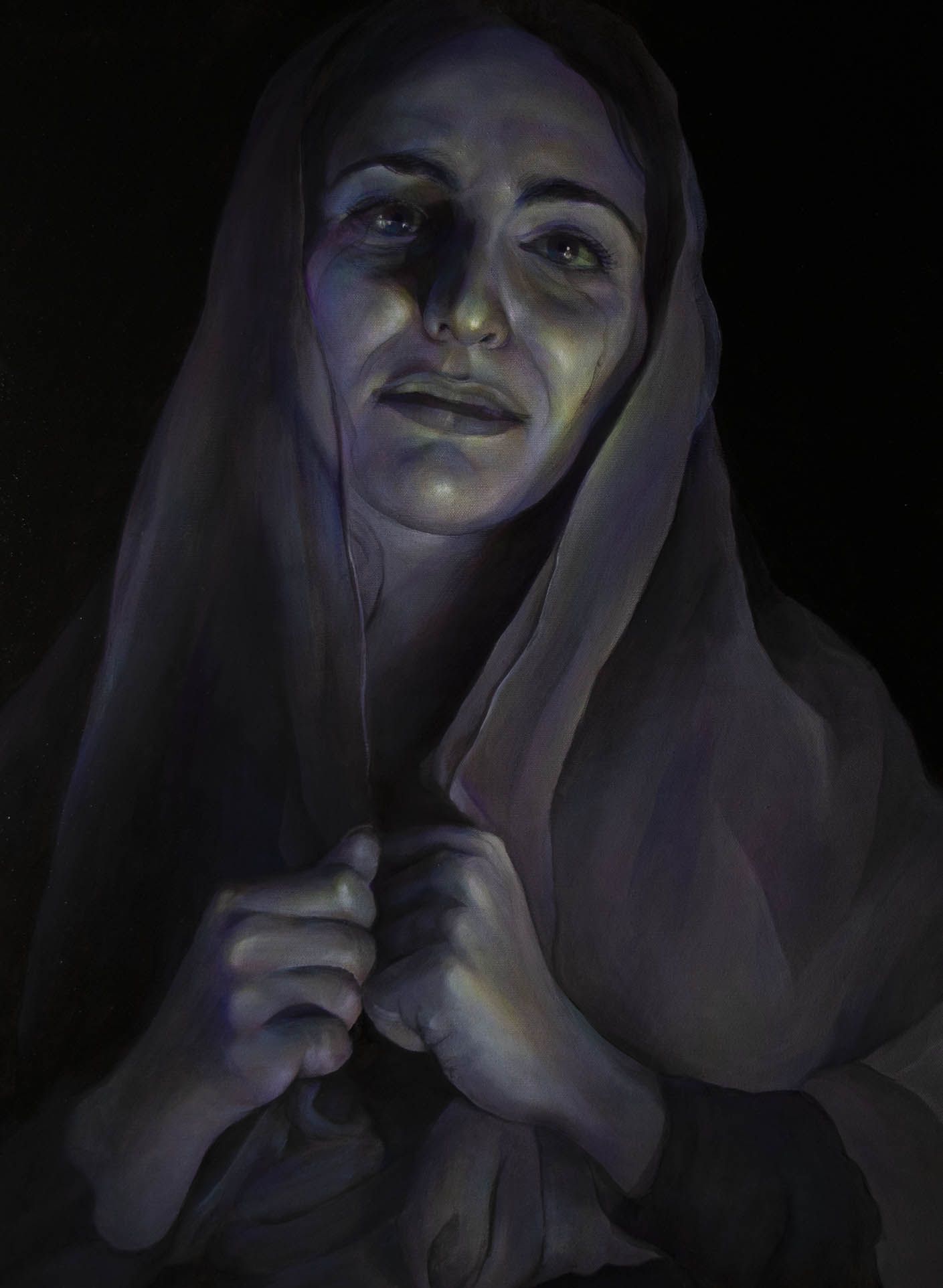
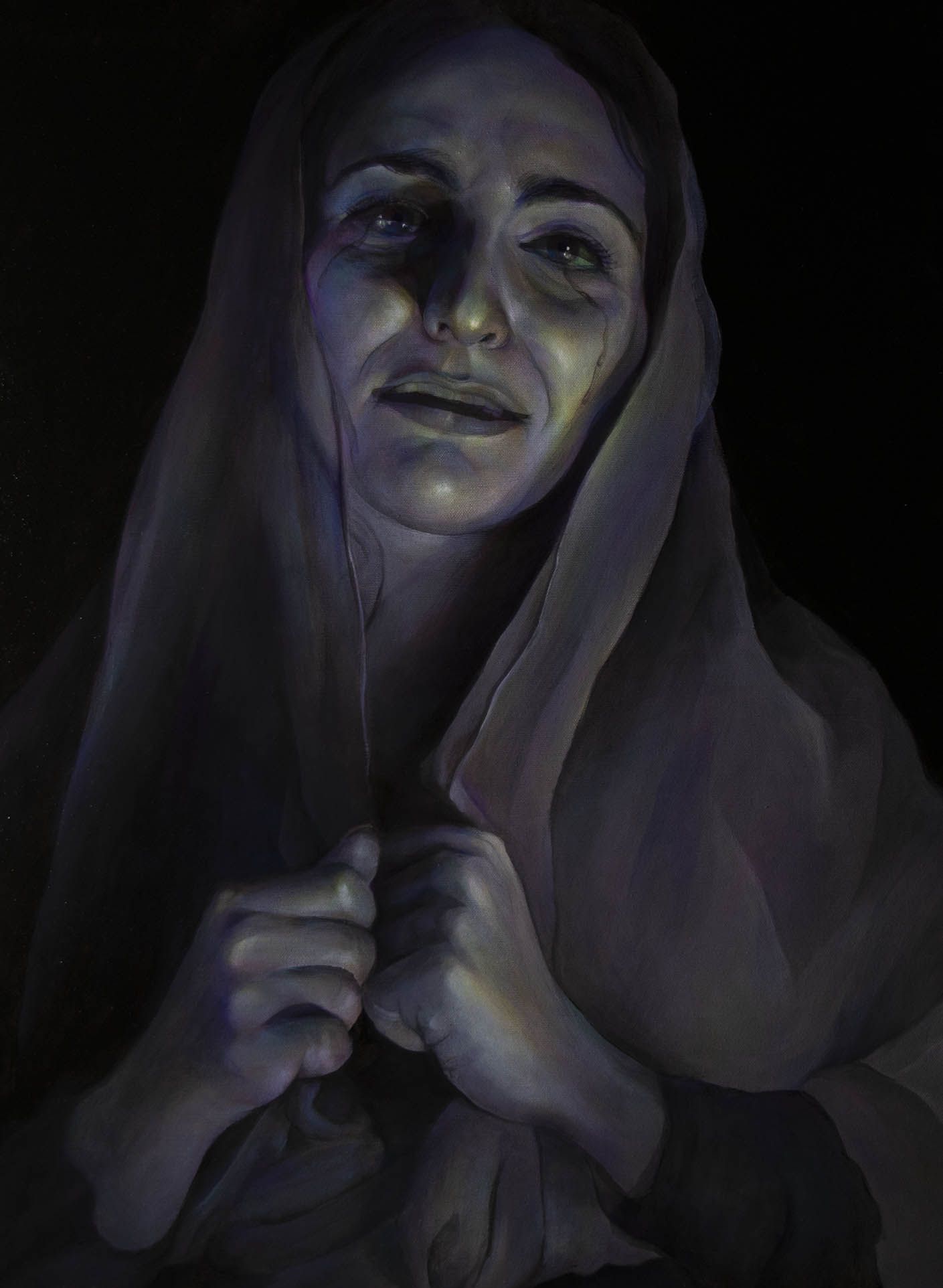
Mary, a passive force in the Enneagram, suffers the passion and death of her son. She represents humanity transforming from a superficial understanding of death (as something immanent and definitive) to a new conception of death as the apparent manifestation of an equally illusory reality. On a more general level, the weeping Madonna is the emblem of the miracle for Catholic society, but what happens if someone reveals that the miracle is artificially induced? The observer moves from a merely superficial, sensational awareness to a deeper and finally authentic understanding: behind the miracle lies a cry of pain, the same cry of a newborn who has just opened his eyes to life.

Judas

A Puppet

Judas, an active force in the Enneagram, triggers the passion and death of Jesus with his betrayal. However, in this particular reading of events, Judas is unaware of the step he is taking. The painting focuses on the concept of unconsciousness: we are like sleepwalkers who in dreams believe they are awake but in reality are moving unconsciously, without any memory of themselves. Thus, Judas believes he is praying but in reality he is clutching the sack of money. He believes he is enriching himself, but in reality, betraying the truth, he is moving toward self-destruction (symbolized by the hanging rope that appears behind his head). Judas is therefore an unconscious puppet, infested by the basest instincts implanted by society: the demons of greed, selfishness, and the thirst for power. The face of Judas is a self-portrait of the author, who represents himself in this guise as a reminder to always stay awake and never subordinate artistic freedom to money: selling freedom means betraying that spark of truth that shines in art.

Maradona

Ecce Homo

Maradona’s story represents a concrete example of how a city can literally deify a human being, and the parable of how events unfolded also provides a rather revealing picture of the consequences this entails. In Naples, Maradona was erected as God, but the weight of omnipotence weighed too heavily on human nature and crushed him in a vortex of narcotics. This escape from reality confronts humanity, in merciless contrast, with its finiteness. Here, then, is man, crowned as God and then scourged by life, only to return to being nothing more than a man, or, to use an expression dear to Neapolitans, a poor Christ.

Hitler/Mother Teresa

Standard

In The Kybalion, one of the seven principles of Hermeticism, “Polarity,” is described as follows: “Opposites share the same nature in varying degrees, extremes meet, all paradoxes can be reconciled.” This painting is a provocation to the intellect of the average man of this age, in which every form of spirituality (except the apparent one, dictated by fashion) has been lost by a materialism that trivializes every aspect of existence, imprisoning it in a cage of rationality. The human intellect is today almost totally trapped in dualism, forced to always choose between yes and no (a binary structure also characteristic of inanimate intelligence). And yet this painting shows us how the dual nature is actually only apparent, illusory, and evanescent. In fact, just as heat and cold are two characteristics of the same entity (temperature) and are measured with the same instrument (the thermometer), good and evil are also two characteristics of the same human nature, and therefore one can transform into the other: cold can become hot, hate can become love.

Jesus

The Last Temptation

Christ, the reconciling force in the Enneagram. He represents the absolute, which, in the process of creating the Universe, separates into yes and no, light and shadow, male and female, good and evil. The death of Jesus, as an absolute, is pure illusion, and represents a transformative phenomenon that recreates the Universe by reconciling opposites, death and life, into a single, complete truth, of which man can only have a glimmer of awareness. Yet in Gethsemane, Jesus prays and asks the Father to remove the chalice of death and suffering he is about to encounter. Thus, unlike “Ecce Homo,” in this painting, it is God’s human nature that makes the truth shine: it makes no sense to deny physical existence by virtue of absolute truth, since, although illusory in and of itself, our perception of it is real, and denying it would be an escape from the world. The invitation is therefore to follow the Master’s example and welcome fear, pain, and suffering, as well as joy and all sensory experiences, so as to transform these impressions into nourishment for spiritual evolution.