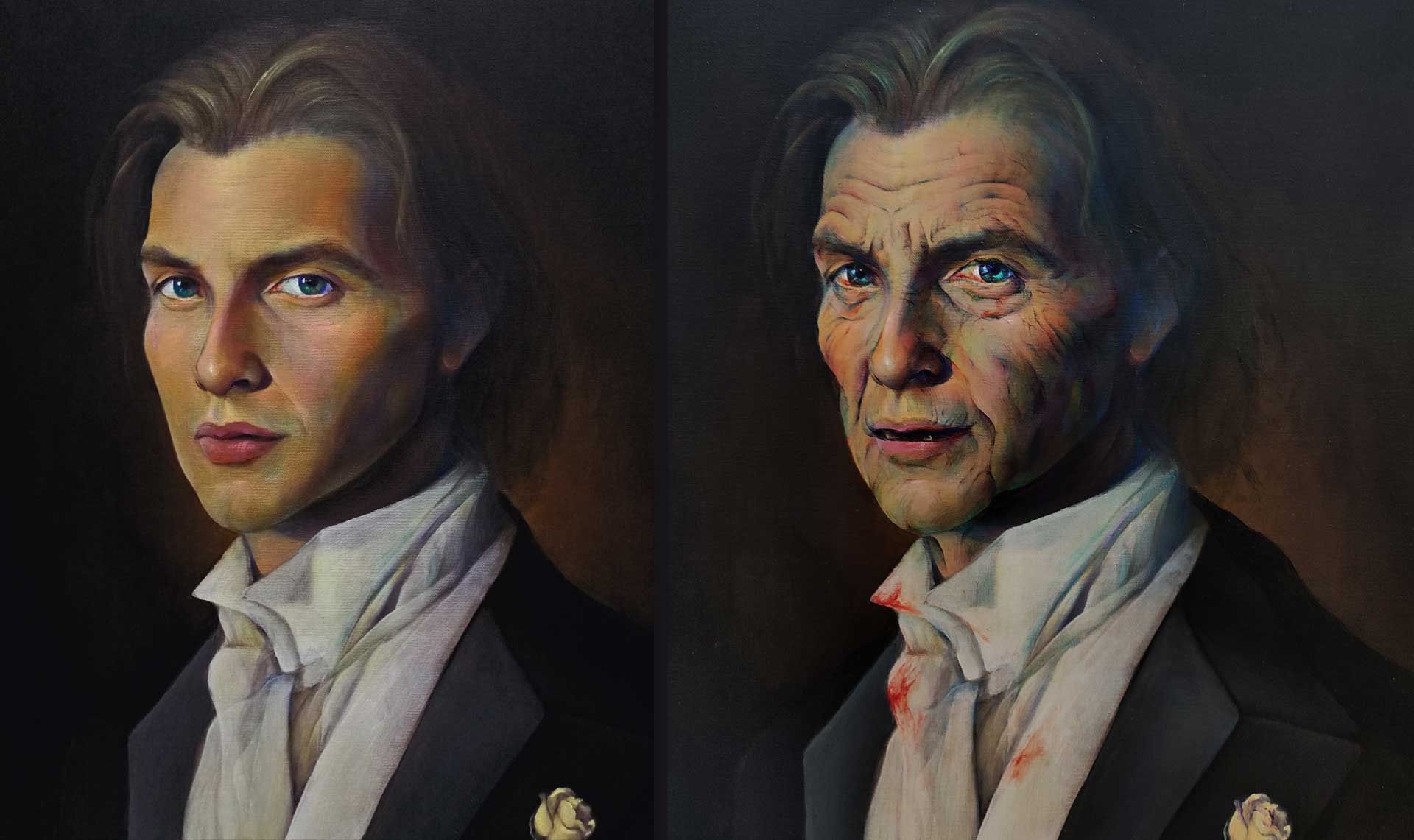
I would have sworn it was magic—if I had any “logic” to spare!—because I had never seen painted figures capable of welcoming my observation, my presence, and, in turn, suspending the hypocrisy of inattention; and of doing so, then, without the aid of technology or optical instruments that artificially influence the external relationship, that is, the observer’s perception.
Don’t be angry with me: painting, like musical scores, cinema, television editing, advertising, language, and even the constant use of digital new media, has always represented the time of the historical animal par excellence, as an object to be fixed in the uniformity or discontinuity of action, appearance, and sensation. Nevertheless, our existences are profoundly tied to immediacy, change, action… Even the history of painting is a history not exempt from the insufficiency of this object, or rather, of sufficient time. Time, therefore, has become a mask, a simulacrum, a definition of art, a theory of humanity. In its continuity, the univocal line of time, which contemporary physics has defined as temporama , is a sophisticated way of pigeonholing, marking, and subtracting.
But authentic, unique, original—what other quality? Ah, there you have it!—revolutionary art is something else entirely, and in this undefined, unlinear nature, it is similar to alchemy, because it is concerned only with what happens, with those extractable fragments that break the web of time. It doesn’t limit itself to performing it, transferring it, making it a way of objectifying it, of thinking about it, of taking pleasure in it.
Francesco Filippelli is the first artist who, like the alchemist in our collective imagination, has addressed time as a face, a framework of transformation, that is, time as the fragmentary subject of occurrence. He has, in short, been concerned with creating by receiving, which, if we wish to be punctual with all human creations, is precisely what color does. The autonomy of its movement is the destructive creator of infinite forms, so the artist, who understands the chemical properties of matter, has made it the alchemical heart of his pictorial research, endowing it with the autonomy to dissolve, sublimate, and then reformulate, thus freeing the image from the regression or prediction of time. He has rethought its synchronicity, recreating what the eyelids of direct, spontaneous observation of life are accustomed to receiving from the interior and exterior of the reality, both material and ideal, in which we are immersed.
How is this possible? Not only is what is known possible, but above all what has remained unthought is, even in the history of painting. Color, in Filippelli’s hands, has been discovered to be syn-kinematic: it acts as a guiding thread that insinuates itself between communicating vessels; and, in our case, color is precisely the transfusion of the temporama; an instantaneous necessity to become, beyond the past, beyond compatibility with the future. The time needed to create the canvas is condensed where perception is impermeable, but not for this reason inscrutable: a consciousness present in the presence of the work of art .
Another notable aspect is his courageous drive; he didn’t simply identify with a new pictorial process, as anyone else would have done, finding himself in the position of dictating painting’s laws. He demonstrates this in the age-old genre of portraiture, which has always been a metaphor for what time fixes, blocks, assembles, determines, introduces, excludes, and conceals in the human being.
It’s clear, then, even to you readers, how the artist has superficially undermined the rhetorical patina of time, which iconography has humanized and which is, to say the least, the most complex to reconsider the gravity of human sensory transformations. Why did he decide to reclaim the botanical labyrinth of portraiture, as it has been historicized thus far?
It did so to reveal the face of the Other in our personal experience. Indeed, I’d be lying to you if I wrote otherwise, because it is precisely on this stage that painting, every century, has drawn its curtain, with the aim of verifying its own anew, its truth, the rearview mirror of its historical and human experience. And isn’t our own stone our bread and butter? And now that we are children of the selfie, of the reproduction and authentication of the NFT, faithful to the thing, close at every distance of any kind, we now need to know that painting is not exhausted with us, that it can unmask the face of the Other above every temporary essence and mythical appearance, that it could finally multiply the spectacle of life, without multimedia compromises, without meddling with the banality of consumption.
Questioning the genre of portraiture means overturning the physiognomic experience of the Other, and with it our own, but I don’t want to convince you of this, because through Filippelli’s canvases, I can invite you to evaluate what I’ve been shown: human, empathetic faces, imbued with a tactile physical and psychological sensation, which transform, shake, and macerate at the foot of the solution of continuity between the front and back of the instant and its fixity; physiognomy sensitive to what senses the passing of human life outside the pictorial antechamber.
I am not at all afraid of exaggerating when I say that Francesco Filippelli’s painting can legitimately stand against time and change the human discourse on sensitive emancipation in contemporary pictorial art.